Skip to content

STEPSS Documentation

Static and Transient Electric Power Systems Simulation. Compute the power flow of a network and simulate its dynamic response to disturbances, under the phasor approximation. Built for power system dynamics research, grid studies and teaching.
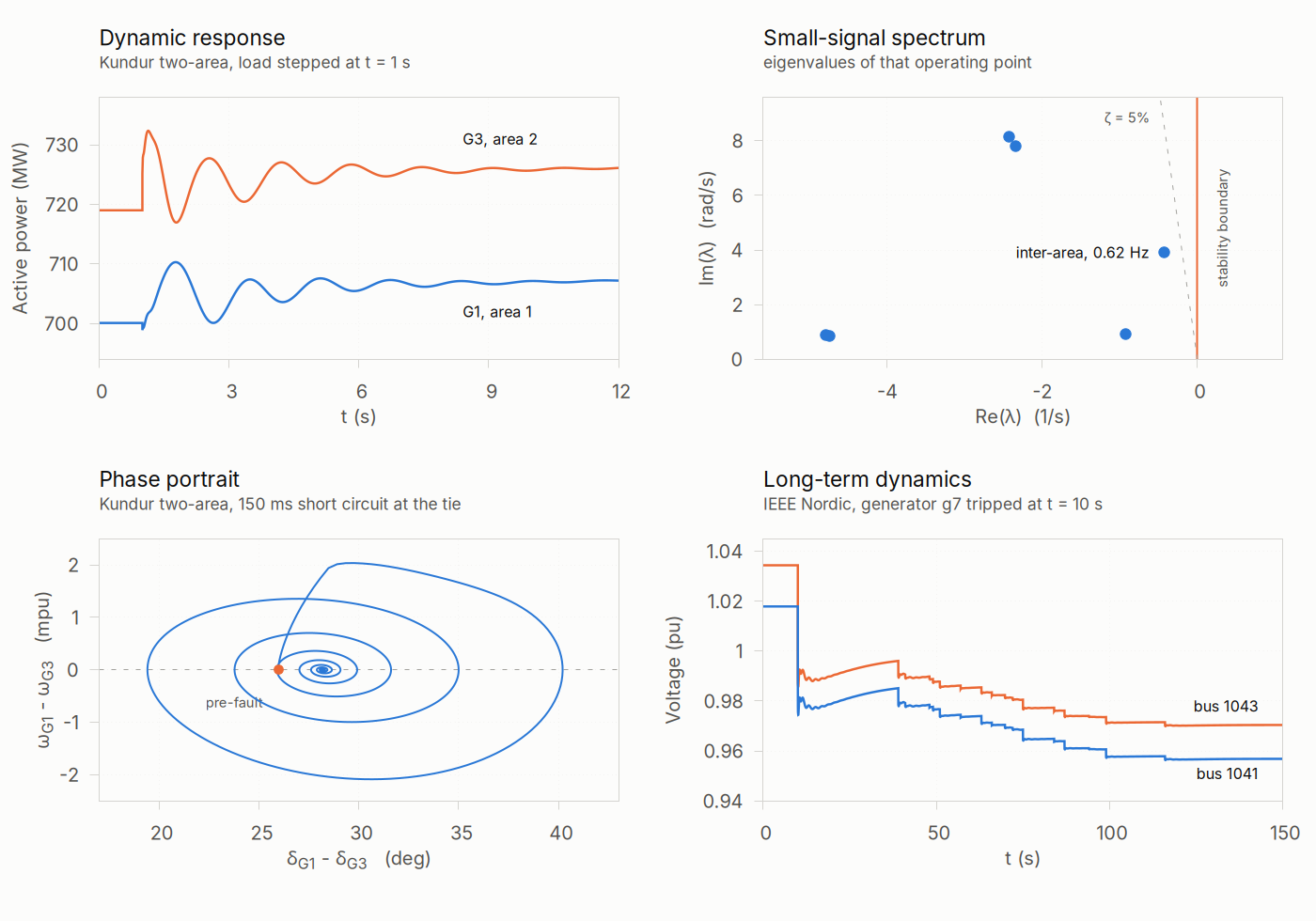
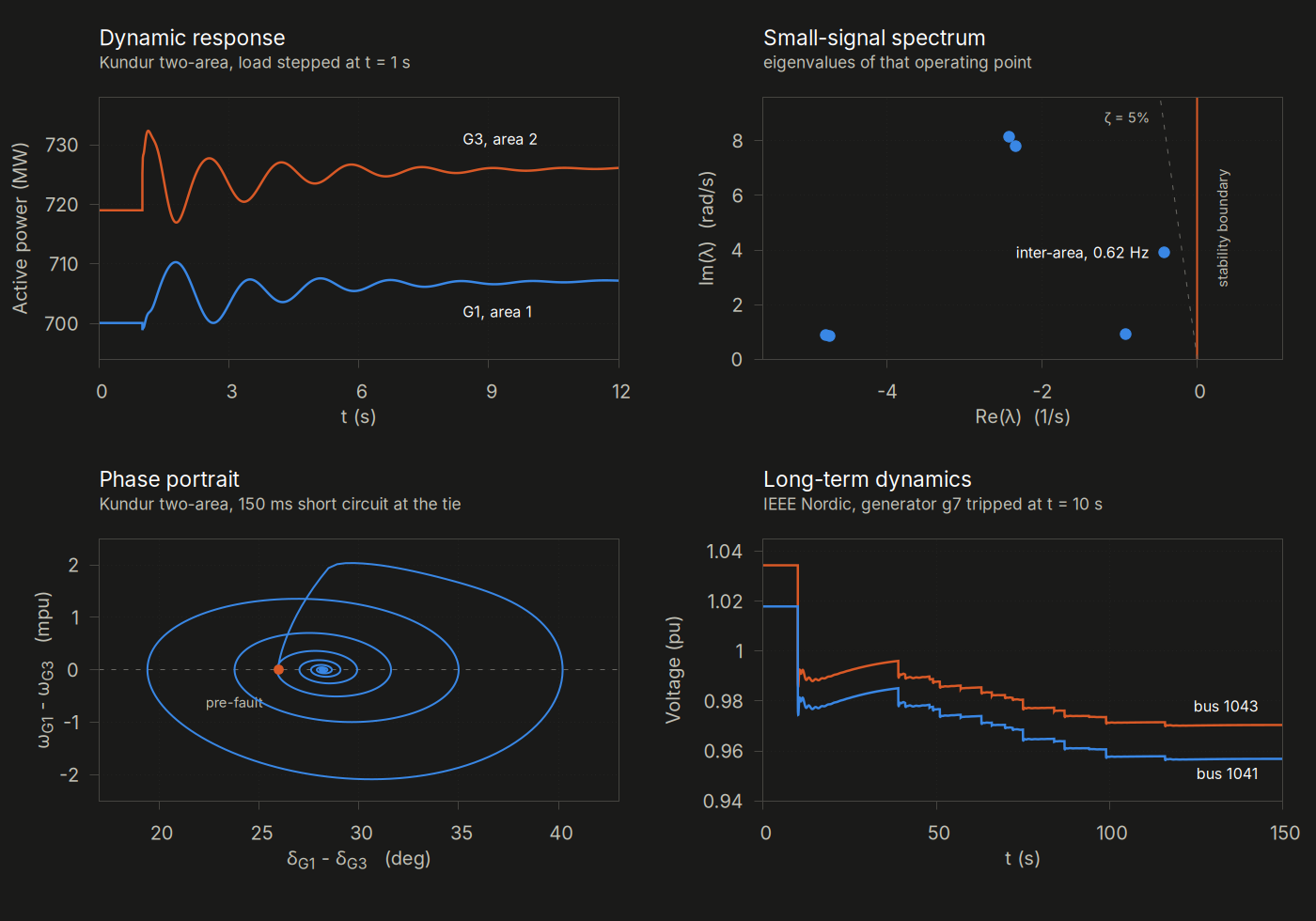
Four panels of results from STEPSS. Dynamic response: generators G1 and G3 of the Kundur two-area system swinging in opposition after a load step, the oscillation decaying over about six seconds. Small-signal spectrum: the eigenvalues of that operating point on the complex plane, all left of the stability boundary, with a 5 per cent damping-ratio line and the 0.62 Hz inter-area mode nearest the boundary. Phase portrait: after a 150 millisecond short circuit at the tie, the angle and speed difference between the two areas spirals out to 40 degrees and back into the equilibrium it started from. Long-term dynamics: bus voltages on the IEEE Nordic system after a generator trip, stepping down and then declining over two minutes in a visible staircase of tap-changer operations. Four panels of results from STEPSS. Dynamic response: generators G1 and G3 of the Kundur two-area system swinging in opposition after a load step, the oscillation decaying over about six seconds. Small-signal spectrum: the eigenvalues of that operating point on the complex plane, all left of the stability boundary, with a 5 per cent damping-ratio line and the 0.62 Hz inter-area mode nearest the boundary. Phase portrait: after a 150 millisecond short circuit at the tie, the angle and speed difference between the two areas spirals out to 40 degrees and back into the equilibrium it started from. Long-term dynamics: bus voltages on the IEEE Nordic system after a generator trip, stepping down and then declining over two minutes in a visible staircase of tap-changer operations.

Milliseconds to minutes, time domain and frequency domain, from two of the bundled test systems. Run the first one yourself.

STEPSS names the platform, not any one program. It reaches you in two editions that drive the same engines and read the same data files, so a case built in one runs unchanged in the other. They do not carry identical toolchains: which edition should I use? sets them side by side.

STEPSS GUI

A desktop application, installed from a .msi, .dmg or .deb that needs nothing else on the machine. Load a network, run static and dynamic simulations, plot live curves, and build your own models, without touching a command line. Open a bundled test system or install it.

STEPSS in Python

pip install stepss. Script simulations, sweep parameters, and work directly with NumPy, SciPy and Jupyter. Install it.

Both editions are front ends onto these engines.

Helios, Power Flow

Newton-Raphson power flow computation in polar coordinates. Determines the initial operating point for dynamic simulations.

RAMSES, Dynamic Simulator

Time-domain simulation of power system dynamics under the phasor approximation. Supports Backward Euler, Trapezoidal, and BDF2 integration with OpenMP parallelism.

CODEGEN, Model Generator

Translates user-defined models into Fortran 2003 code for compilation and linking with RAMSES. Build models visually with CODEGEN Studio. Carried by STEPSS GUI.