

Network Modeling
The network model includes buses, lines, cables, transformers, switches, and shunts.
In dynamic simulations with RAMSES, the only parameter associated with a bus is its nominal voltage (RMS line-to-line voltage), used as base voltage for per-unit conversions.
Two buses with different nominal voltages cannot be connected through lines or switches.
Data Format
Section titled “Data Format”BUS NAME VNOM ;| Field | Description |
|---|---|
NAME | Bus name (max 8 characters) |
VNOM | Nominal voltage in kV |
Only one BUS record per bus is allowed. All buses must be declared before being referenced.
Lines and Cables
Section titled “Lines and Cables”Modeling
Section titled “Modeling”Lines and cables use the same pi-equivalent model with series resistance , series reactance , and half-shunt susceptance . Shunt conductances are neglected.
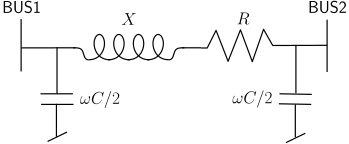
Under the phasor approximation, series capacitors can also be modeled with this pi-equivalent by setting , , and to a negative value.
Data Format
Section titled “Data Format”LINE NAME BUS1 BUS2 R X WC2 SNOM BR ;| Field | Description | Unit |
|---|---|---|
NAME | Line name (max 20 characters) | |
BUS1 | First bus name | |
BUS2 | Second bus name | |
R | Series resistance | Ω |
X | Series reactance | Ω |
WC2 | Half shunt susceptance | μS |
SNOM | Nominal apparent power, used to display line loading or in user-defined models (0 = infinite) | MVA |
BR | Breaker status (0 = open, other = closed) |
Line orientation is arbitrary: BUS1 and BUS2 may be swapped. Only one LINE record per line is allowed.
Lines must not connect two buses with different nominal voltages.
Switches
Section titled “Switches”A switch is a connection without impedance between two buses, treated internally as a very short line with , , and set to a very small value. Thus it has no active power losses and negligible reactive power losses.
Data Format
Section titled “Data Format”SWITCH NAME BUS1 BUS2 BR ;| Field | Description |
|---|---|
NAME | Switch name (max 20 characters) |
BUS1 | First bus name (max 8 characters) |
BUS2 | Second bus name (max 8 characters) |
BR | Status (0 = open, other = closed) |
Switch orientation is arbitrary: BUS1 and BUS2 may be swapped. Only one SWITCH record per switch is allowed.
Switches must not connect two buses with different nominal voltages.
All switches are memorized, even those which are open. An open switch has zero power flow but can be put into service during dynamic simulation.
Transformers
Section titled “Transformers”Modeling
Section titled “Modeling”Transformers are represented by a two-port model with:
- Series resistance (copper losses)
- Leakage reactance
- Magnetizing susceptances and (negative values). Usually one of them is zero.
- Transformer ratio magnitude and phase angle . A phase-shifting transformer is characterized by a nonzero value of .
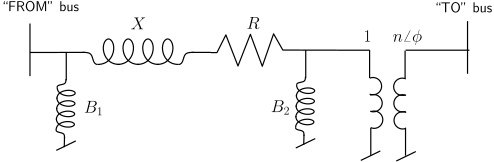
Iron losses are neglected (no shunt resistance). , , , and are specified on the “from” side.
Base Conversions
Section titled “Base Conversions”Manufacturer Data Conversion
Section titled “Manufacturer Data Conversion”The values of , , , and relate to the following characteristics from manufacturer data:
- : nominal apparent power
- (resp. ): nominal voltage on the “from” (resp. “to”) side
- (resp. ): series resistance (resp. Leakage reactance) in per unit on the base
- and : shunt susceptances in per unit on the base
- and : open-circuit voltages corresponding to the transformer ratio (very often and )
Let and be the nominal voltages of the “from” and “to” buses, as specified in their BUS records.
Parameters are specified in percent on the base:
Data Format: Full Model (TRANSFO)
Section titled “Data Format: Full Model (TRANSFO)”TRANSFO NAME FROMBUS TOBUS R X B1 B2 N PHI SNOM BR ;| Field | Description | Unit |
|---|---|---|
NAME | Transformer name (max 20 characters) | |
FROMBUS | ”From” bus name | |
TOBUS | ”To” bus name | |
R | Series resistance | % |
X | Leakage reactance | % |
B1 | Shunt susceptance (from side) | % |
B2 | Shunt susceptance (to side) | % |
N | Transformer ratio magnitude | % |
PHI | Transformer ratio phase angle | degree |
SNOM | Nominal apparent power (must not be zero) | MVA |
BR | Breaker status |
Only one TRANSFO or TRFO record per transformer is allowed.
Data Format: Combined Model (TRFO)
Section titled “Data Format: Combined Model (TRFO)”TRFO NAME FROMBUS TOBUS CONBUS R X B N SNOM NFIRST NLAST NBPOS TOLV VDES BR ;This simplified model has and , and combines the transformer model with load tap changer (LTC) data for the power flow in a single record. The LTC fields (CONBUS, NFIRST, NLAST, NBPOS, TOLV, VDES) carry the information needed to adjust the transformer ratio during power flow computation. These fields are not used by RAMSES during dynamic simulation. It cannot be used for phase-shifting transformers.
To control the transformer ratio during dynamic simulation, associate a DCTL LTC controller with the transformer.
See Power Flow for details on ratio adjustment.
| Field | Description | Unit |
|---|---|---|
NAME | Transformer name (max 20 characters) | |
FROMBUS | ”From” bus name (max 8 characters) | |
TOBUS | ”To” bus name (max 8 characters) | |
CONBUS | Controlled bus for power flow ratio adjustment (max 8 characters). Not used by RAMSES, but a dummy name must be provided | |
R | Series resistance | % |
X | Leakage reactance | % |
B | Shunt susceptance (from side; ) | % |
N | Transformer ratio magnitude | % |
SNOM | Nominal apparent power (must not be zero) | MVA |
NFIRST | Ratio at first tap position (lower bound), used by the power flow for ratio adjustment | % |
NLAST | Ratio at last tap position (upper bound), used by the power flow for ratio adjustment | % |
NBPOS | Number of tap positions (including first and last), used by the power flow for ratio adjustment | |
TOLV | Voltage tolerance for tap adjustment, used by the power flow | pu |
VDES | Desired controlled bus voltage, used by the power flow | pu |
BR | Breaker status (0 = open/out of service, other = closed/in service) |
Non-Reciprocal Two-Ports
Section titled “Non-Reciprocal Two-Ports”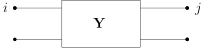
A non-reciprocal two-port has a non-symmetric nodal admittance matrix:
with and .
Typically, non-reciprocal two-ports are produced when reducing a network that includes phase-shifting transformers, to obtain an equivalent.
Data Format
Section titled “Data Format”NRTP NAME FROMBUS TOBUS GIJ BIJ GJI BJI GSI BSI GSJ BSJ BR ;| Field | Description |
|---|---|
NAME | Name of the two-port (max 20 characters) |
FROMBUS | Name of bus (max 8 characters) |
TOBUS | Name of bus (max 8 characters) |
GIJ | Conductance from to (pu on nominal bus voltages and system base power) |
BIJ | Susceptance from to (pu) |
GJI | Conductance from to (pu) |
BJI | Susceptance from to (pu) |
GSI | Shunt conductance at bus (pu) |
BSI | Shunt susceptance at bus (pu) |
GSJ | Shunt conductance at bus (pu) |
BSJ | Shunt susceptance at bus (pu) |
BR | Breaker status (1 = closed/in service, 0 = open/out of service) |
The orientation is not arbitrary: FROMBUS and TOBUS cannot be swapped. Only one NRTP record per two-port is allowed.
A non-reciprocal two-port is treated as a piece of equipment; hence, the presence of the BR field.
Shunts
Section titled “Shunts”Modeling
Section titled “Modeling”The shunt element is a purely reactive, constant shunt admittance. The reactive power it produces varies with the square of the voltage:
where is the susceptance. The element is a capacitor () or a reactor ().
Data Format
Section titled “Data Format”SHUNT NAME BUS_NAME QNOM BR ;| Field | Description | Unit |
|---|---|---|
NAME | Shunt name (max 20 characters) | |
BUS_NAME | Name of the bus to which the shunt is connected (max 8 characters) | |
QNOM | Nominal reactive power produced by the shunt at the nominal bus voltage (positive = capacitor, negative = reactor) | Mvar |
BR | Breaker status (1 = in service, 0 = out of service) |
Only one SHUNT record per named shunt is allowed. Multiple shunts at the same bus are allowed, each with its own name; in this case, the susceptances are added (taking signs into account).
All shunts are memorized, even those which are disconnected. A disconnected shunt has zero power flow but can be put into service during dynamic simulation.
Next Steps
Section titled “Next Steps”- Power Flow, Configure generators, loads, and compute the initial operating point
- Dynamic Data Records, Add synchronous machines and controllers