

Reference Frames & Initialization
Phasor Approximation
Section titled “Phasor Approximation”Under the phasor approximation, the network equations are:
where is the vector of complex currents, is the vector of complex voltages, and is the bus admittance matrix.
In dynamic regime, each synchronous machine defines a local frequency. In most cases, those frequencies remain close to the nominal frequency . The admittances in are computed at frequency .
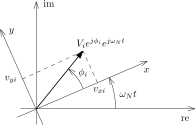
The voltage at bus takes the form:
In rectangular coordinates on the axes rotating at :
where is the voltage phasor in rectangular coordinates on axes rotating at .
In RAMSES, the rectangular components are used rather than the polar components .
Synchronous Reference Frame
Section titled “Synchronous Reference Frame”The axes rotating at form a synchronous reference. After a disturbance, the system may settle at a different frequency , unless its model includes an infinite bus imposing . Phasor components then oscillate at , although the system is at equilibrium from a practical viewpoint. Tracking these oscillations requires a small time step, making the synchronous reference unsuitable for long-term simulations.
This reference is suited for short-term simulations or when the model includes an infinite bus driving the frequency back to .
In fact, any speed can be considered for the reference axes . The only constraint is that all voltage and current phasors refer to the same axes.
Center of Inertia (COI) Reference
Section titled “Center of Inertia (COI) Reference”In the COI reference, the axes rotate at:
where is the total number of synchronous machines, is the rotor speed of the -th machine, and is its nominal apparent power (in MVA).
is the inertia coefficient of the -th machine.
When the system reaches equilibrium at frequency , all phasor components tend to constant values, enabling larger time steps. The COI reference is well suited for long-term simulations.
Implementation
Section titled “Implementation”To preserve model sparsity despite the global coupling in the COI equation, the value of at the previous time step is used.
See: D. Fabozzi and T. Van Cutsem, “On angle references in long-term time-domain simulations,” IEEE Trans. Power Systems, Vol. 26, No. 1, pp. 483-484, Feb. 2011.
The COI frequency can be used as an average system frequency in injector and two-port models.
Specifying the Reference Frame
Section titled “Specifying the Reference Frame”The reference is specified in Solver Settings via:
$OMEGA_REF SYN ; # Synchronous reference$OMEGA_REF COI ; # Center of inertia referenceThe presence of a Thévenin equivalent (infinite bus) forces the synchronous reference.
Network Equations
Section titled “Network Equations”With all phasors referred to the axes, the network equations decompose into:
where is the conductance matrix and the susceptance matrix. Decomposing into real and imaginary parts yields:
For a network with buses, there are equations involving variables.
Initialization Procedure
Section titled “Initialization Procedure”The dynamic simulation is initialized as follows:
-
Start from initial bus voltages (from the power flow solution)
-
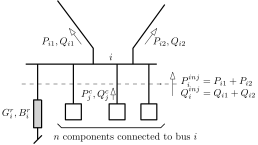
Compute power flows in network branches and shunts
-
Determine bus power injections by summing flows at incident branches
A positive value of (resp. ) corresponds to power entering the network.
-
Share bus injection among components using one of two methods:
- (i) Explicit powers: ,
- (ii) Fractions: ,
These methods are mutually exclusive: and .
Although and are typically in the interval , negative values or values larger than one are allowed.
-
Assign remaining power to an impedance load:
If the unassigned power is above an internal tolerance, an automatic constant-admittance load (named M_bus) is created:
A large value of or may be intentional (when a load is modeled as a constant shunt admittance), but it may also result from a mistake in the initial power balance.
Initialization Output Example
Section titled “Initialization Output Example”NUMBER OF IMPEDANCE LOADS : 3 (M_ type: 3 )
load name bus name P Q
M_2 2 90.002 17.997M_3 3 0.013 -0.011M_4 4 -0.017 -0.022Here, M_3 and M_4 are negligible (rounding artifacts), while M_2 suggests a missing load specification at bus 2.
Next Steps
Section titled “Next Steps”- Dynamic Data Records, Define SYNC_MACH, INJEC, and TWOP records
- Disturbances, Define simulation events