

5-Bus Test System
The 5-bus test system is a minimal power system suitable for learning the STEPSS tools and experimenting with dynamic simulation concepts. It is small enough to trace every computation step while still demonstrating the full simulation workflow, and runs in either edition: in Python as shown below, or in STEPSS GUI, which ships it as a bundled example.
Repository: SPS-L/stepss-5-bus-test-system
One-line Diagram
Section titled “One-line Diagram”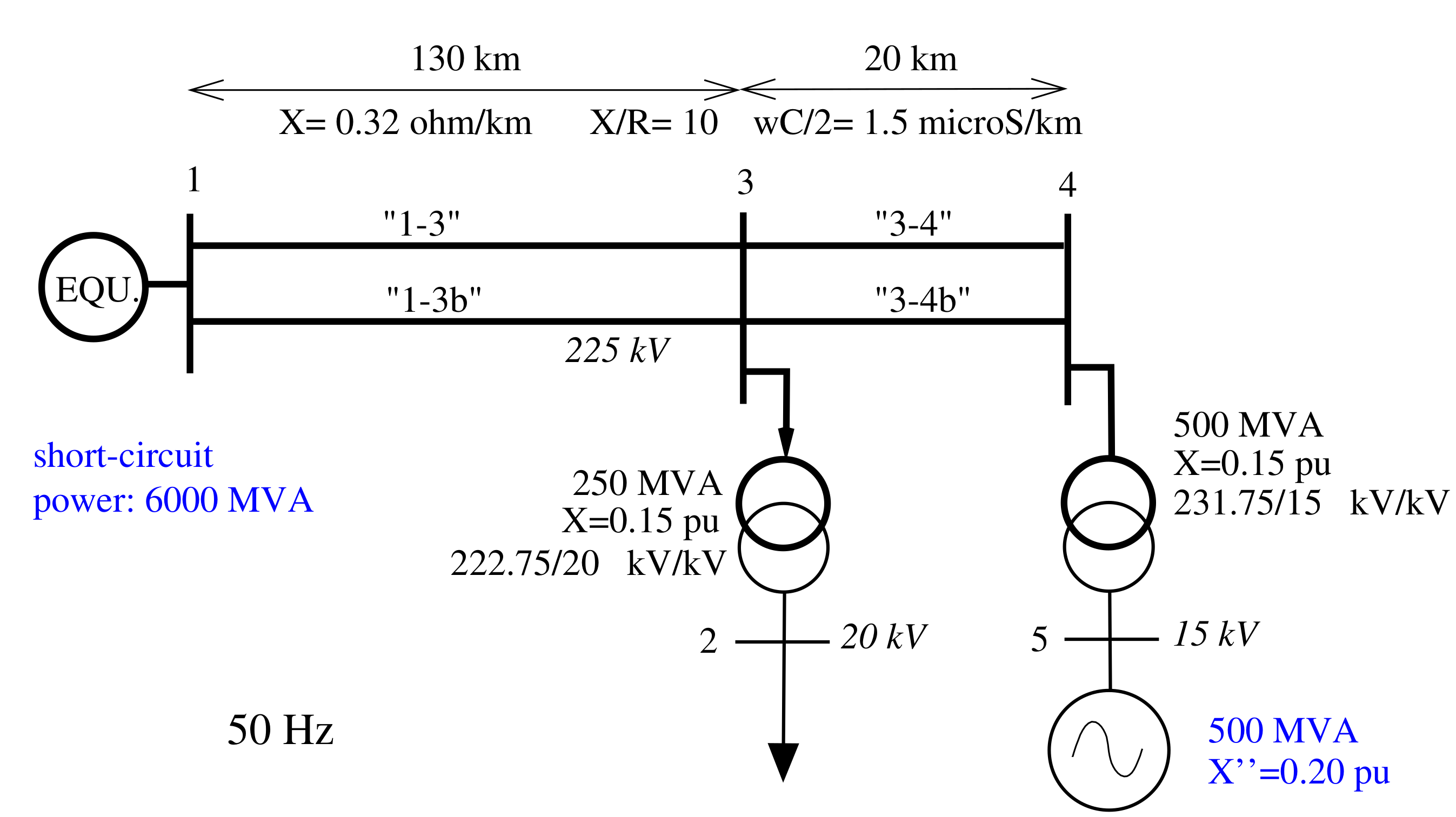
Quick Start
Section titled “Quick Start”import stepssimport os
# Configure the test casecase = stepss.cfg()case.addData('dyn.dat') # dynamic model datacase.addData('lf1solv.dat') # power-flow solutioncase.addData('solveroptions.dat') # solver settingscase.addDst('nothing.dst') # no pre-defined disturbancescase.addObs('obs.dat') # observables to recordcase.addTrj('output.trj') # trajectory output file
# Remove stale output files from previous runsfor f in os.listdir('.'): if f.endswith('.trj') or f.endswith('.trace'): os.remove(f)
# Run simulation with exciter setpoint changeram = stepss.sim()ram.execSim(case, 0.0)ram.addDisturb(1.0, 'CHGPRM EXC G Vo 0.05 2') # +0.05 pu step on Vo at t=1 sram.contSim(60.0)ram.endSim()
# Extract and plot resultsext = stepss.extractor(case.getTrj())ext.getSync('G').P.plot() # active powerext.getSync('G').Q.plot() # reactive powerDownload
Section titled “Download”The test system files are available in the stepss-5-bus-test-system repository.
See Also
Section titled “See Also”- Test Systems, the other benchmark networks
- Python API Examples, Complete Python simulation workflow with this test system