

Power Flow (PFC & Helios)
STEPSS provides two power-flow engines:
- PFC — the original Fortran implementation.
- Helios — a modern C++ reimplementation that reads the same data format and produces numerically equivalent results. Helios is the actively developed engine and the recommended choice going forward.
Everything on this page applies to both engines unless marked otherwise; where the text says “PFC”, read it as the power-flow computation performed by either engine. The few implementation differences are summarised at the end of this page.
The power flow uses the following network records documented in Network Modeling: BUS, LINE, SWITCH, TRANSFO, TRFO, NRTP.
The additional records specific to power flow computations are documented below.
Load and Shunt Data
Section titled “Load and Shunt Data”Load and shunt data are specified in an extended version of the BUS record:
BUS NAME VNOM PLOAD QLOAD BSHUNT QSHUNT ;| Field | Description | Unit |
|---|---|---|
NAME | Bus name (max 8 characters) | |
VNOM | Nominal voltage | kV |
PLOAD | Total active power load (positive = consumed) | MW |
QLOAD | Total reactive power load (positive = consumed) | Mvar |
BSHUNT | Nominal reactive power of constant-susceptance shunt: the reactive power produced under the nominal voltage of the bus (positive = capacitor, negative = reactor) | Mvar |
QSHUNT | Reactive power of constant-power shunt (positive = capacitor) | Mvar |
If no load is connected to the bus, set PLOAD and QLOAD to zero. If no shunt is connected, set BSHUNT and QSHUNT to zero.
The total reactive power produced by both shunt components:
Generator Data
Section titled “Generator Data”GENER NAME BUS P Q VIMP SNOM QMIN QMAX BR ;| Field | Description | Unit |
|---|---|---|
NAME | Generator name (max 20 characters) | |
BUS | Connection bus name | |
P | Active power produced | MW |
Q | Reactive power produced (ignored if VIMP ≠ 0) | Mvar |
VIMP | Imposed voltage (0 = PQ bus, nonzero = PV bus) | pu |
SNOM | Nominal apparent power | MVA |
QMIN | Lower reactive power limit | Mvar |
QMAX | Upper reactive power limit | Mvar |
BR | Breaker status (0 = open) |
For PV buses, if the upper reactive power limit QMAX is exceeded, the bus switches to PQ type with QMAX enforced, and Newton iterations continue. If subsequently the bus voltage rises above VIMP, the bus switches back to PV type. Similarly, if QMIN is exceeded, the bus switches to PQ type with QMIN enforced; it switches back to PV if the voltage subsequently drops below VIMP.
QMIN and QMAX are used only if VIMP is nonzero (PV bus).
An extended variant with active power limits and a participation factor exists:
GENER NAME BUS P Q VIMP SNOM QMIN QMAX PMIN PMAX PART BR ;| Field | Description | Unit |
|---|---|---|
PMIN | Minimum active power the generator can produce | MW |
PMAX | Maximum active power the generator can produce | MW |
PART | Participation factor used when redistributing an active power imbalance |
PMIN/PMAX are not enforced during Newton iterations. They are used to clamp the specified P before the computation (the slack generator is exempted; in Helios this exemption can be disabled with $PLIM 0), and together with PART when generation is redispatched after system modifications or contingencies.
Both variants also accept an additional bus-name field between BUS and P (making 10 or 13 fields in total); that field is accepted and ignored by both engines.
Only one generator is allowed per bus.
All generators are memorized, even those which are disconnected. A disconnected generator has zero power output but can be put into service during dynamic simulation.
Slack Bus
Section titled “Slack Bus”A slack bus is mandatory for power flow computations: not all buses can be of PV or PQ type, since this would require knowing the active power losses in the network before performing the calculation.
A PV-type generator must be connected to the slack bus. Its voltage magnitude (from the GENER record) is imposed, and the voltage phase angle is set to zero.
SLACK NAME ;| Field | Description |
|---|---|
NAME | Bus name (max 8 characters) |
There must be exactly one SLACK record in the data.
PFC can handle only one connected network (island). If the graph is disconnected, only the sub-network containing the slack bus is treated; the rest is ignored with a warning.
Static Var Compensators (SVC)
Section titled “Static Var Compensators (SVC)”Although reference is made to an SVC, the model can be used in general for any component controlling voltage with a droop. The SVC is assumed lossless: the active current injected at the controlled bus is zero.
The SVC is modeled with a controllable susceptance at a controlled bus , regulating the voltage at a monitored bus :
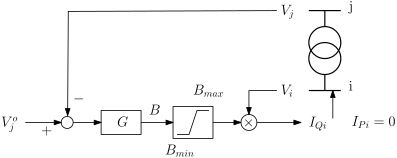
Data Format
Section titled “Data Format”SVC NAME CON_BUS MON_BUS V0 Q0 SNOM BMAX BMIN G BR ;| Field | Description | Unit |
|---|---|---|
NAME | SVC name (max 20 characters) | |
CON_BUS | Controlled bus where the susceptance is varied (max 8 characters) | |
MON_BUS | Monitored bus whose voltage is regulated (max 8 characters) | |
V0 | Voltage setpoint (0 = constant power mode with , , no limits tested) | pu |
Q0 | Reactive power setpoint (ignored if V0 ≠ 0) | Mvar |
SNOM | Nominal reactive power | Mvar |
BMAX | Maximal nominal reactive power: reactive power produced under pu when | Mvar |
BMIN | Minimal nominal reactive power: reactive power produced under pu when | Mvar |
G | Gain, in pu on the (, SNOM) base, where is the nominal voltage at the controlled bus | pu |
BR | Breaker status (0 = open, other = closed) |
It is common for BMAX to be positive and BMIN negative, but other combinations are allowed.
For SVCs with nonzero V0, the voltage control equation is solved initially. If the susceptance upper limit BMAX is exceeded, the limit is enforced and Newton iterations continue. The SVC reverts to voltage control when . Similarly, if BMIN is exceeded, the lower limit is enforced; the SVC reverts when .
Only one SVC is allowed per bus. It is not allowed to connect both a generator and an SVC to the same bus.
All SVCs are memorized, even those which are disconnected. A disconnected SVC can be put into service during dynamic simulation.
Transformer Ratio Adjustment for Voltage Control
Section titled “Transformer Ratio Adjustment for Voltage Control”PFC can adjust the ratio of a designated transformer to bring a controlled voltage inside a deadband , where is the desired voltage and is the tolerance.
The ratio is changed in discrete steps between a minimum and maximum value. During computation, the ratio is changed by one step at a time, after which Newton iterations run until convergence. The process repeats until the controlled voltage falls in the deadband. When multiple transformers are adjusted, some may reach their deadbands before others.
Via TRFO Record
Section titled “Via TRFO Record”The controlled bus is CONBUS in the TRFO record. This must be one of the two ending buses of the transformer. An empty or blank string enclosed within quotes indicates that the transformer ratio is not to be adjusted; in this case, dummy values must still be provided for the remaining fields.
The ratio corresponding to tap position ():
The initial ratio from the N field of the TRFO record is adjusted to the nearest tap position before starting the power flow computation.
Relevant fields in the TRFO record:
| Field | Description | Unit |
|---|---|---|
NFIRST | Ratio at first tap position (lower bound) | % |
NLAST | Ratio at last tap position (upper bound) | % |
NBPOS | Total number of tap positions (including first and last) | |
TOLV | Voltage tolerance | pu |
VDES | Desired voltage | pu |
Via LTC-V Record
Section titled “Via LTC-V Record”The second way to specify ratio adjustment is through a separate LTC-V record. This is more natural in association with a TRANSFO record.
LTC-V NAME CON_BUS NFIRST NLAST NBPOS TOLV VDES ;| Field | Description | Unit |
|---|---|---|
NAME | Name of the controlled transformer (max 20 characters) | |
CON_BUS | Controlled bus (max 8 characters) | |
NFIRST | Ratio at first tap position (lower bound) | % |
NLAST | Ratio at last tap position (upper bound) | % |
NBPOS | Total number of tap positions (including first and last) | |
TOLV | Voltage tolerance | pu |
VDES | Desired voltage | pu |
A transformer can be controlled by a single tap changer only. The LTC-V record can also be associated with a TRFO record, provided that no adjustment is specified in the TRFO record itself.
Phase-Shifting Transformer Adjustment (PSHIFT-P)
Section titled “Phase-Shifting Transformer Adjustment (PSHIFT-P)”PFC can adjust the phase angle of a transformer to bring the active power flow in a monitored branch inside a deadband . The adjustment mechanism is similar to the in-phase ratio adjustment described above.
PSHIFT-P CONTRFO MONBRANCH PHAFIRST PHALAST NBPOS SIGN PDES TOLP ;| Field | Description | Unit |
|---|---|---|
CONTRFO | Name of the transformer whose phase angle is adjusted (max 20 characters, defined in a TRFO or TRANSFO record). If the transformer does not exist, the record is ignored with a warning | |
MONBRANCH | Name of the branch where active power is monitored (max 20 characters, defined in a LINE, TRFO, or TRANSFO record). is the active power leaving the first bus of the branch record | |
PHAFIRST | Phase angle at first tap position (lower bound) | degrees |
PHALAST | Phase angle at last tap position (upper bound) | degrees |
NBPOS | Number of tap positions | |
SIGN | Direction indicator: 1 means must increase to increase power flow; -1 means decrease. Any other value causes the program to stop | |
PDES | Desired active power flow | MW |
TOLP | Tolerance | MW |
The phase angle at tap position () is:
The initial phase angle from the PHI field of the TRANSFO record is adjusted to the nearest tap position before starting the power flow computation.
PFC performs a sensitivity analysis to determine whether the phase angle should be increased or decreased. If this analysis indicates a direction opposite to SIGN, a warning is issued and SIGN is ignored. On output, PFC sets SIGN to the value from its sensitivity analysis.
Only one PSHIFT-P record per transformer is allowed. The PSHIFT-P record is intended for use with a TRANSFO record, but can also be used with a TRFO record (in which case the angle is initialized to zero).
A transformer cannot be controlled by both an LTC-V and a PSHIFT-P record.
Bus Voltages: Initial Values and Results (LFRESV)
Section titled “Bus Voltages: Initial Values and Results (LFRESV)”On output, PFC produces a file with the computed bus voltage magnitudes and phase angles. These are stored in LFRESV records. The syntax is:
LFRESV BUS MODV PHASV ;| Field | Description | Unit |
|---|---|---|
BUS | Bus name (max 8 characters) | |
MODV | Voltage magnitude | pu |
PHASV | Voltage phase angle, referenced to slack bus | radians |
PFC Computation Control Parameters
Section titled “PFC Computation Control Parameters”PFC uses Newton–Raphson iterations to solve the power flow equations. Convergence is achieved when both the active and reactive power mismatches fall below specified thresholds, all transformer ratio and phase-shift controls are satisfied, and all generators and SVCs are within their reactive limits.
Three convergence indices are used:
- : largest absolute mismatch of the active power equations
- : largest absolute mismatch of the reactive power equations
- : largest apparent power mismatch, used to trigger limit checks (via
$MISQLIM), Jacobian freezing (via$MISBLOC), and transformer adjustments (via$MISADJ)
The following records control the computation. Each record starts with $ and has a single numeric field.
| Parameter | Default | Unit | Description |
|---|---|---|---|
$SBASE | 100 | MVA | System base power (on which pu values are expressed) |
$TOLAC | 0.1 | MW | Convergence tolerance on active power mismatch () |
$TOLREAC | 0.1 | Mvar | Convergence tolerance on reactive power mismatch () |
$NBITMA | 20 | Maximum number of Newton iterations | |
$MISQLIM | 20 | MVA | Apparent power mismatch threshold below which generator/SVC reactive limits are checked and enforced (set to 0 to skip) |
$MISBLOC | 10 | MVA | Apparent power mismatch threshold below which the Jacobian is kept constant (see note below for the Helios behaviour) |
$MISADJ | 10 | MVA | Apparent power mismatch threshold below which transformer ratios and phase shifts are adjusted (set to 0 to skip) |
$DIVDET | 0 | Set to 1 to activate divergence detection; 0 to skip | |
$PLIM | 1 | Helios only. 1 = the slack generator’s PMIN/PMAX are bypassed during initial P clamping (the PFC behaviour); 0 = the slack is clamped like any other generator |
Implementation Differences (PFC vs Helios)
Section titled “Implementation Differences (PFC vs Helios)”The two engines read the same data format and produce numerically equivalent results. The differences that can matter in practice:
| Aspect | PFC (Fortran) | Helios (C++) |
|---|---|---|
| Sparse linear solver | MA37 (HSL) | KLU (SuiteSparse) |
$MISBLOC | Jacobian values and factorization frozen below the threshold | Jacobian recomputed every iteration; the threshold only controls whether the factorization reuses the previous pivot ordering. Iteration counts can therefore differ slightly |
$PLIM | Not available (slack P limits always bypassed) | Available; default 1 reproduces the PFC behaviour |
| BUS record | 6 fields required | QSHUNT optional (5 fields accepted, defaults to 0) |
PSHIFT-I (current-controlled phase shifter) | Accepted (stored, not adjusted) | Not supported — hard error |
TURLIM (legacy P-limit record) | Accepted for compatibility | Not supported — hard error; use the extended GENER variant |
| Unknown records | Handled or error | Warned and skipped |
| Numerical output | Reference | May differ in the last displayed decimal, due to the different linear solvers |
Record Sharing Between PFC and RAMSES
Section titled “Record Sharing Between PFC and RAMSES”The following table summarises which records are used by PFC and RAMSES respectively.
| Record | PFC | RAMSES |
|---|---|---|
| BUS | All 6 fields | First 2 fields (NAME, VNOM) |
| LINE | All fields | All fields |
| SWITCH | All fields | All fields |
| NRTP | All fields | All fields |
| TRANSFO | All fields | All fields |
| TRFO | All fields | Fields 1–9 and 15 only |
| SHUNT | Ignored | All fields |
| GENER | All fields | Ignored |
| SVC | All fields | Ignored |
| SLACK | Used | Used |
| LFRESV | Input: initial values; Output: solution | Input: initial values for RAMSES |
| LTC-V | Used | Ignored |
| PSHIFT-P | Used | Ignored |
Next Steps
Section titled “Next Steps”- Reference Frames & Initialization, Understand how RAMSES initializes from the PFC solution
- Dynamic Models, Define synchronous machines, injectors, and controllers